
Intermediate Microeconomics Practice, Part 1
IMEX1

[Last updated, May 6th 2026]
Budget constraints:
1.1: Max has income of m= 16 and faces the following issue governing the prices of two goods: Cookies (Good X) and Coffee (Good Y). The price of coffee is always $2 per glass. The government wants to discourage cookie consumption so adds a $1 per cookie tax after you’ve purchased four cookies. Put differently, cookies sell for $1 per cookie for the first four cookies Max buys, but then $2 per cookie for any additional cookies beyond four. Draw Max’s budget constraint.
Preferences:
2.1: Could the following choices have been made by a consumer with a valid preference structure, if so, which type? If not, explain why inconsistent with valid preferences.
2.1a: When the consumer’s budget set consisted of the following bundles: (6,2), (2,6), and (4,4). They chose (6,2). When their budget set consisted of (8,1), (3,6), and (5,4), they chose (8,1). Lastly when their budget set was (10,0), (4,5) and (6,3) they chose (10,0).
2.1b: When the consumer’s budget set consisted of the following bundles: (5,5), (8,2) and (2,8). They chose (5,5). When their budget set consisted of (6,6), (10,3) and (3,10) they chose (6,6). Lastly when their budget set was (7,7), (12,4) and (4,12), they chose (7.7).
2.1c: When the consumer’s budget set consisted of the following bundles: (8,2), (5,5), and (2,8). They chose (5,5). When their budget set consisted of (10,1), (6,4) and (4,6) they chose (6,4). Lastly when their budget set was (9,3), (7,5) and (5,7) they chose (7,5).
2.1d: When the consumer’s budget set consisted of the following bundles: (6,4) and (4,6) they chose (6,4). When their budget set consisted of (6,4) and (8,2) they chose (8,2). Lastly when their budget set was (4,6) and (8,2) they chose (4,6).
2.2: Consider the following choices observed from a consumer under the following circumstances. What does this behavior suggest about Good 1 and Good 2?
2.2a: When the consumer’s budget set consisted of the following bundles: (4,1), (4,5) and (4,9) they chose (4,1). When their budget set consisted of (6,2), (6,7), and (6,10), they chose (6,2). Lastly when their budget set was (8,0), (8,4), and (8,8) they chose (8,0).
2.2b: When the consumer’s budget set consisted of the following bundles: (3,1), (3,5), and (3,9) they chose (3,1). When their budget set consisted of (3,1), (3,9), and (3,5) they chose (3,5). Lastly when their budget set was (3,9), (3,5), and (3,1) they chose (3,9).
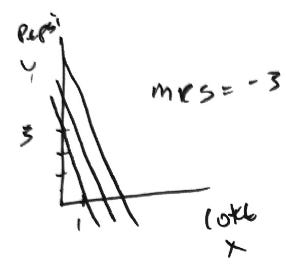
2.3: Bob is always willing to trade Pepsi (Y) for Coke (X) at a constant rate of 3 Pepsi for 1 Coke. What sort of preferences does this suggest for Bob? Draw Bob’s Indifference curves.
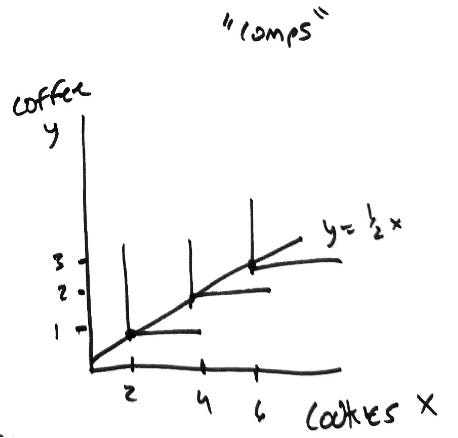
2.4: Ann always wants to consume 2 cookies (X) with each 1 coffee (Y). What sort of preferences does this suggest for Ann? Draw Ann’s Indifference curves.
Utility:
3.1: Bob is always willing to trade Pepsi (Y) for Coke (X) at a constant rate of 3 Pepsi for 1 Coke. Write down a utility function that is consistent with Bob’s preferences.
3.2: Ann always wants to consume 2 cookies (X) with each 1 coffee (Y). Write down a utility function that is consistent with Ann’s preferences.
Choice:
4.1:
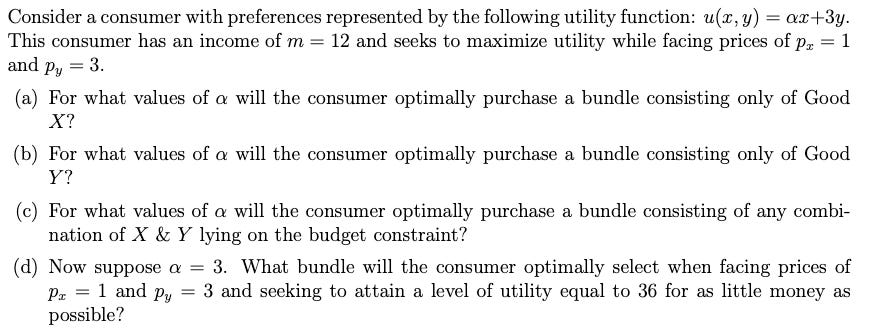
4.2:
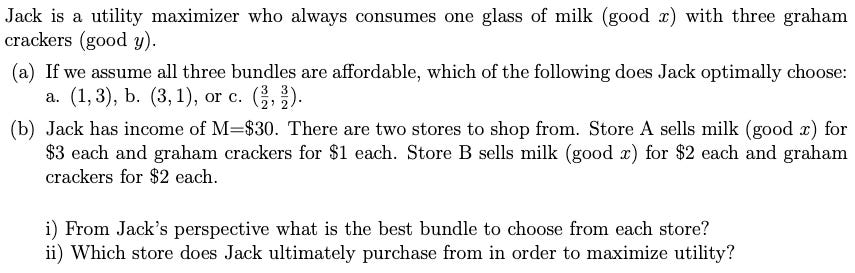
4.3: Max has income of m= 16 and faces the following issue governing the prices of two goods: Cookies (Good X) and Coffee (Good Y). The price of coffee is always $2 per glass. The government wants to discourage cookie consumption so adds a $1 per cookie tax after you’ve purchased four cookies. Put differently, cookies sell for $1 per cookie for the first four cookies Max buys, but then $2 per cookie for any additional cookies beyond four.
4.4: There are four people in our economy with preferences described by the utility functions below. For each consumer, find their utility maximizing bundle of goods when each has a budget of m=24 available and p_x = 2 and p_y = 1. Show all work!
a. Ann: u_a = 2x + 3y
b. Bob: u_b = min{2x, y}
c. Charlie: u_c = xy
d. Dana: u_d = x + 2ln(y)
e. Do any of these consumers have identical preferences to anyone else? Explain
4.5: Solve the consumer utility maximization problem when faced with budget constraint: 2x+3y=60 and with preferences represented by: u(x,y) = min{3x, 5y}.
4.6: Find the utility maximizing bundle for a consumer with income of 80 facing prices of p_1=3 and p_2=2 with preferences represented by: u(x_1, x_2) =16x_1 + 5x_2
4.7: Consider a consumer with utility function u(c, d) = cd, where c is coffee and d is donuts. The prices are pc = 2 and pd = 1.
(a) Set up the Lagrangian and solve for the cheapest bundle that achieves utility level ū = 36.
(b) What is the minimum income required to purchase this bundle?
4.8: Consider a person with utility described by: u(x,y) = xy
a. Using the Lagragian method solve the consumer’s expenditure minimization problem assuming they seek to achieve a bundle yielding a utility level of 50 when p_x = 1 and p_y=2.
b. What is the smallest amount of money the consumer will need to meet this goal?
c. What fraction of their income does this consumer spend on Good X? On Good Y? What if p_x and p_y change? How do you know?
Demand: TBD
Substitution and Income Effects:
6.1 A consumer chooses bundles of goods X and Y. The price of Y is fixed at pY = 1 in all situations. Initially, the price of X is pX = 2 and income is M = 40. The consumer chooses: A = (8, 24). Then the price of X increases to pX‘ = 4. The consumer chooses:
B = (4, 24). With a voucher (compensated income), the consumer chooses: C = (7, 26)
(a) Compute the total effect: XB - XA. Interpret your result.
(b) Compute the substitution effect: SE = XC - XA. State the sign and explain.
(c) Compute the income effect: IE = XB - XC. State the sign and explain.
(d) Is X a normal or inferior good? Explain.
(e) For each utility function below, state whether it is consistent or inconsistent with the three observed bundles A, B, C and your decomposition of the total effect into substitution and income effects. Base your answer on the shape of the indifference curves (perfect substitutes, perfect complements, or strictly convex) and on whether the goods are normal or inferior. Provide a short explanation for each utility function:
U1 = X + Y
U2 = min{X, 2Y}
U3 = X^(1/2)Y^(1/2)
U4 = X^(1/4)Y^(3/4)
%%%%%%%%%%%%%%%%%%%%%%%%%%%%%%%%%%%%%%%%%%%%%%
Sketch of solutions:
%%%%%%%%%%%%%%%%%%%%%%%%%%%%%%%%%%%%%%%%%%%%%%
Budget 1:
1.1: Vertical intercept is (0,8) because 16/2=8. Kink occurs at 4 cookies and since Max expends $4 to reach that point the Horizontal intercept is (10,0). After spending $4 to buy the first 4 cookies, max has $12 remaining to buy cookies at a price of $2 each so buys at most an additional 6 cookies. Alternatively Max could buy 6 coffees at the same price. Hence the kink point is (4,6). Top portion of BC has slope of 1/2 and bottom portion costs 2.
Preferences 2:
2.1a: The consumer always selects the bundle with the most Good 1, even if those bundles contain relatively little Good 2. This is consistent with perfect substitutes where Good 1 is valued much more highly.
2.1b: The consumer consistently selects balanced bundles. This is characteristic of perfect complements, specifically where 1 unit of Good 1 is used with every 1 unit of Good 2.
2.1c: This consumer seems to value variety and interior bundles, but doesn’t seem to insist on the same fixed proportions. This is most consistent with ‘well-behaved preferences’ such as Cobb-Douglas.
2.1d: These choices cycle and notice that they violate transitivity! Not a valid preference structure & the corresponding indifference curves would cross.
2.2a: The consumer always chooses the smallest amount of Good 2, holding Good 1 fixed. This suggests that Good 2 is a bad!
2.2b: The consumer selected a different bundle from the same budget, each of three times. The consumer’s behavior suggests that they are indifferent between these bundles i.e. utility is not changing with the amount of Good 2, so Good 2 is neutral.
2.3: Bob has ‘substitutes’ preferences. Downward sloping indifference curves with slope of -3.
2.4: Ann has “complements” preferences. The trick to drawing the indifference curves is first finding the line that crosses from the origin through each corner. This will correspond exactly to ideal bundles for Ann, such as x=2, y=1; x=4, y=2; x=6, y=3. So we recognize that x=2y and the line y=(1/2)x creates a ray through the origin crossing the corners of each IC:
Utility 3:
3.1: Bob’s Marginal Rate of Substitution (MRS) is -3 which means the ratio of the marginal utility of x to the marginal utility of y must equal -3, meaning: MUx/MUy = -3. The simplest utility function is U(x,y) = 3x + y.
3.2: The composition of Ann’s bundle requires x = 2y. We can insert this into generic perfect complements utility, replacing the equals sign with a comma: U(X,Y) = min{aX, bY} becomes U(X,Y) = min{x, 2y} for Ann.
Choice 4:
4.1:
4.2: For both stores, the ray through the origin that captures Jack’s optimal bundles at the corners of the IC’s is: y= 3x. Store A yields budget constraint of 3x+y= 12 so Jack consumes: x= 5,y= 15 which yields utility of 15. Store B yields budget x+ 3y= 12 and then Jack consumes x= 3,y= 9, this yields utility of 9.
4.3
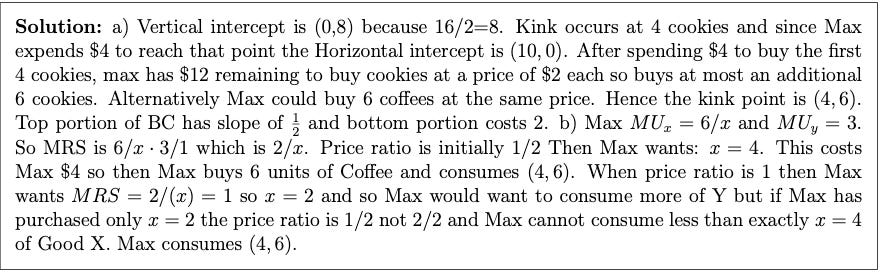
4.4
a) MRS = 2/3 < 2/1 =px/py, so it’s an ``Ally’’ solution with y=24/1 = 24 and x=0.
b) Find the ray from the origin connecting all the corners of the level sets of the utility function: y= 2x, then plug into the budget constraint: 2x + y =24 and then: 2x + (2x) = 24 so 4x = 24 or x = 6, then y=12. Check exhausted budget: (6) + (12) = 24.
c) Cobb-Douglas: x=(1/2)*(24/2)=6 and y=1/2*24/1=12
d) Q-L: MRS = MUx/MUy = (1/2y) = (1/1) (y/2) and y* = 2. Then plug into BC: 2x + 1y=24 so 2x + 2 = 24 and then x=11
e) No one has identical preferences--none of these utility functions are a monotone transformation of each other--it’s just a coincidence that Bob and Charlie buy the same bundle.
4.5: 3x=5y and then x=(5/3)y so 2x+5(3/5)x) = 60 and then 2x + 3x = 75 and so x=15 and y=9
4.6: 16/5 > 3/2. AllX: x_1=5, x_2 =0
4.7: We minimize expenditure subject to a utility constraint.
Expenditure function: E = 2c + d and Constraint: c · d = 36, so we write:
Lagrangian: L = 2c + d + λ(36 − cd)
First-order conditions:
2 − λd = 0
1 − λc = 0
Solve for λ:
λ = 2/d and λ = 1/c so then set equal: 2/d = 1/c, so d = 2c. And then substitute into constraint: c(2c) = 36 or 2c^2 = 36 which is c^2 = 18, hence c = 3 and so then d = 6. Optimal bundle: (3, 6).
(b) Minimum income required: 12 because Cost: E = 2(3) + 6 = 12
4.8:
Tangency condition: lambda = 1/y = 2/x then x = 2y so then (2y)(y) = 50) or 2y^2 =50. So y^2 = 25, so y=5. Then x=10. So u(10,5) = 10*5 = 50 and,
b. the expenditure is; 1(10) + 2(5) = 20.
c. The consumers demands for x=(1/2)M/Px and y=(1/2)M/Py show that the consumer will always spend half its income on X and half on Y, because: xPx = 1/2M and yPy = (1/2)M, where xPx is the expenditure on X and xPy is the expenditure on Y. This observation therefore holds regardless of price changes.
Demand 5: TBD
SE & IE 6:
6.1:
(a) Total Effect: 4 - 8 = -4, consumer reduces X by 4 units.
(b) Substitution Effect: 7 - 8 = -1 , substitution away from X.
(c) Income Effect: 4 - 7 = -3, loss of real income reduces X.
(d) X is a normal good because the income effect is negative.
(e)
U1: Inconsistent (corner solutions)
U2: Inconsistent (no substitution effect)
U3: Consistent (convex, normal goods)
U4: Consistent (convex, normal goods)