
Chapter 3: Utility

Now that we have developed some terminology for describing consumer preferences formally, we move to a tractable model that operationalizes these assumptions and implications: Utility
We define a consumers utility to be the well-being received through behavior and consumption.
We represent an agent’s preferences with a utility function that takes as its inputs the levels of the goods consumed and returns as its output a numerical value.
Importantly, utility is an ordinal concept rather than a cardinal concept.
We care about the relative ranking of bundles, not the magnitude of the utility derived.
Ex. If u(x1, x2) = 10 and u(y1, y2) = 2...
We can only say that the consumer prefers bundle X to bundle Y . We absolutely cannot make statements about how much more preferred X is to Y . It’s nonsense (and incorrect) to say that X is five times more preferred than Y. As a consequence, utility functions are not unique. We could equivalently represent the preferences with w(·) where: w(x1,x2) = 1 and w(y1,y2) = −1.
If bundle X is weakly preferred to Y any valid utility function must assign a number at least as high to X as to Y
• Ex: U(1 unit of coffee) = 10, U(1 unit of cookies) = 0, and
U (1 unit of oatmeal) = −5 represents the same preferences as X ≽ Y , Y ≽ Z, and X ≽ Z.
We care only about the rank of utilities; the actual numbers are less interesting. Furthermore, a utility function that preserves the rank will also preserve the underlying preferences:
U(coffee) = 1000, U( cookies) = 999, U(oatmeal) = 998 is just as good as:
U(coffee) = 10, U(cookies) = 0, U(oatmeal) = −5
Utility functions are unique only up to a positive monotone transformation
• If X ≻Y and g(X)>g(Y), where g is a monotone increasing function then...
v(X,Y) = g(u(X,Y)) is an equivalent utility function to u(X,Y).
Ex. If u(x1, x2) = 10 and u(y1, y2) = 2...
Consider the “doubling function” which is a positive monotone transformation: v(·) = 2u(·), which preserves the ordering of the ranking of bundles by returning:
Consider the “negative function” which is a not a positive monotone transformation: w(·) = −u(·), which destroys the ordering of the ranking of bundles by returning:
Indeed, any strictly increasing monotone transformation of a utility function represents the same preferences as the original
This is because an increasing function will preserve the rank of the utilities, and therefore preserve the same preferences
Examples: ln(x) and e^x, x^n where n is odd, xn where x ≥ 0, x +c for any constant c, and cx for any c > 0 i.e. we’re talking about things where g always has a positive derivative.
Non-examples: sine and cosine functions, raising to positive power when the function is defined over negative values i.e. xn where x < 0, and multiplication by a negative.
Nevertheless for the purposes of solving the consumer’s problem we’re not really directly interested in utility by itself but actually more interested in how utility changes with adjustments to consumption patterns.
We care about marginal utility defined as the incremental benefit from consuming an additional unit. Formally the marginal utility of x is:
“The extra utility from an additional unit of good x”
Similarly the marginal utility of y is:
What we are building to is the concept of marginal rate of substitution or MRS.
This measure reports the willingness of a consumer to substitute between goods and is formally defined as the ratio of marginal utilities:
“This is the maximum amount of one good that a consumer will trade to obtain an additional unit of the other good”
For our purposes, the MRS is “How much y they will give up to get one more unit of x”
Let’s explore the relationship between MRS and marginal utility more carefully:
We can write the change in utility associated with a change in consumption...
• Of good x:
• Of good y:
Here we want to read dUx as the change in utility due to change in the consumption of good x, we read MUx as the marginal utility of x, and we read dx as the change in consumption of good x.
The total change in utility if I trade-off y for x is:
If I impose the requirement of maintaining the same level of utility or, equivalently, remaining on the same indifference curve, this total change is zero!
The change in utility when staying on one indifference curve is zero:
Rearranging:
“Additional benefit coming through x matches the loss from giving up y”
But then:
The last term is just the slope of the IC!
Great! But then how do we calculate marginal utilities? Let’s start over and write things differently. Start with: dUx = MUxdx and dUy = MUydy
We’ll read dUx as the “change in utility coming through changes in x”, we’ll read MUx as the benefit of additional x, and we’ll read dx as the change in x. Now write instead: MUx = dUx/dx and MUy = dUy/dy. Or just: MUx =dU/dx and MUy =dU/dy
Which brings us to:
We can now examine marginal utilities in the context of several common preference shapes.
Perfect substitutes:
U (x , y ) = ax + by
• MUx = a
• MUy = b
• MUx =MRS = a/b, the slope of the indifference curves!
Perfect complements:
U(x, y) = min{ax, by}
The coefficients a and b are positive and indicate the proportions in which the goods are consumed.
• MUx = a if ax ≤ by and 0 if by ≤ ax
• MUy = 0 if ax ≤ by and b if b y ≤ ax
• MUx/MUy = MRS = ∞, undefined, or 0.
The MRS is pretty much nonsense here given there’s no substitutability (perfect complements)
Cobb Douglas:
The MRS derived from Cobb-Douglas preferences is the slope of the indifference curve at the point corresponding to the current bundle (x, y) consumed.
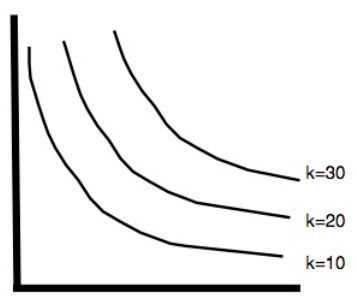
Indifference curves and utility functions: Consider a utility function u(x1, x2) = x1x2
Fix a level of utility and find all combinations of x1 & x2 that gives that level.
Changing the fixed level gets different indifference curvesTo draw these resulting indifference curves we need to draw level sets of the function, that is, the set of all (x1,x2) such that u(x1, x2) is a constant.
u(x1,x2) = k = x1x2
See also: