
Chapter 10: Cost minimization

To produce a given quantity at a minimum cost, the firm uses information about its production function and input prices. In the long run all inputs are variable so the long run cost will be lower than the short run cost if the short run use of inputs is suboptimal.
In both the long run and short run the firm chooses the bundle of inputs with the lowest cost of production. This is economically efficient. We introduce the concept of isocosts. Separating out each input’s contribution to total cost, the firm’s total cost is the sum of its expenditure on labor and capital: C = wL + rK.
There are many possible combinations of labor and capital that all cost the same to use. These are represented by the isocost lines, one for each cost level. Along an isocost we fix a particular cost level:
Features of isocosts:
Where isocost hit capital and labor axes, depends on the cost, c, and input prices. These intercepts correspond to the situation where the firm uses only labor or capital.
Isocosts further from the origin correspond to higher costs. Isoscosts have intercepts C/r and C/w so increases in costs shift isocosts outward, moving to a higher isocost.
The slope of an isocosts is given by: dK/dL = -w/r which depends on the relative price of inputs.
In order to minimize costs:
Low isocost rule: Pick the bundle of inputs where the lowest feasible isocost touches tangent to the isoquant.
Pick the bundle where the isoquant is tangent to isocost line
Last-dollar rule: Pick bundle of inputs where last dollar spent on one input gives as much extra output as last dollar psent on any other input. In order to minimize the cost of producing level of output a firm choose inputs so marginal rate of technical substitution equals relative input prices:
\(\substack{MRTS= -\frac{W}{R} \\\\\\\\\\\\ \frac{-MP_L}{MP_K} = -\frac{w}{r} \\\\\\\\\\\ \frac{MP_L}{w} = \frac{MP_K}{r} }\)Last dollar rule says costs minimized if inputs are chosen so that the last dollar spent on labor adds as much output as the last dollar spent on capital.
Firm’s minimization problem:
This is the Lagrangian function for constrained optimization. The wL + rK portion is the objective function and the F(L,K) - Q is the constraint. Lambda is the Lagrangian multiplier that justifies us writing these two as a single equation. Noting that the constraint drops out whenever F(L,K) - Q = 0, you can think of Lambda as the ``penalty for violating the constraint’’.
We take the partial derivatives with respect to each input and the Lagrangian multiplier and then solve the system of equations. We plug that result into the constraint to solve back for L* and K*
Solving we arrive at:
We substitute this into the constraint and solve for L* and K*
Before we explore implications for cost minimization let’s recall the interpretation of marginal rate of technical substitution.
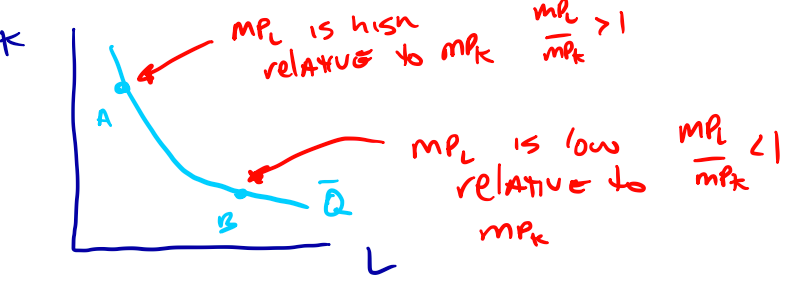
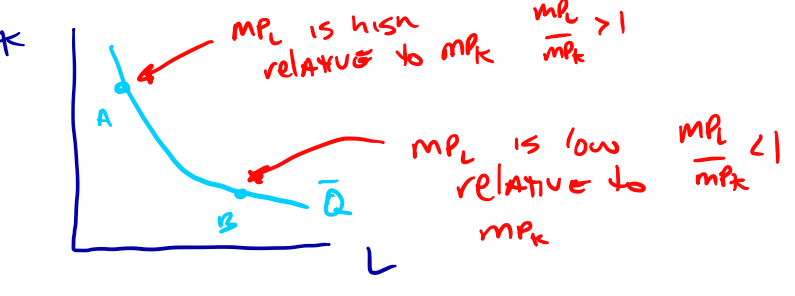
1.) The slope of the isoquant gives the tradeoff between productive abilities of labor and capital within the given production process (technology).
At point A, the isoquant is steep: the firm can reduce capital a great deal while increasing labor only a small amount, while maintaining the same output.
At point B: Firm wants to reduce capital a little bit and must increase labor a great deal to keep output at the same level.
The negative of the slope of the isoquant is MRTS of one unit (x-axis) for another (y-axis)
Substitutability:
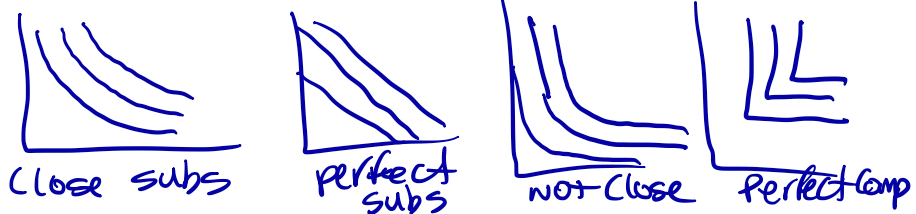
The curvature of an isoquant shows how readily substitutable one input is for another.
Straight isoquant implies the degree of substitutability does not depend on current quantities employed. The MRTS doesn’t change along the isoquant
Curved isoquants imply the MRTS changes considerably along the isoquant. The two inputs are poor substitutes for each other. The relative substitutability of one for the other depends quite a bit on the amount currently employed.
An isocost connects all the combinations of capital and labor a firm can purchase for a given total expenditure (cost) on inputs. C=rK+wL where r is the ‘rental rate of capital and w is the ‘wage’.
The slope -w/r tells us about the tradeoffs at the margin. It’s reflecting the consequences of trading off one input for another. It answers the question ``how much more of one input a firm could hire, without increasing overall expenditure on inputs, if it uses less of the other’’.
If the isocost is steep, labor is relatively expensive compared to capital (assuming capital is on the vertical and labor on the horizontal axis). If the firm wants to use more labor without increasing expenditure it must use much less capital. If the price of labor is relatively cheap compared to capital the isocost line will be flat. The firm could hire a lot more labor and not have to give up as much capital to so do while expenditure is constant.